Doctor of Philosophy (Ph.D)

Duration: 2 Years

Cohort Start: 7th June 2026
  • Research-Intensive Ph.D. Program Designed for Future Scholars & Thought Leaders
  • Achieve the Coveted "Dr." Title with Globally Benchmarked Doctoral Standards
  • Publish, Present & Innovate Through Structured Research Methodology
  • Prepare for Careers in Academia, Policy Research, and High-Level Consultancy
Admission Open Registration Deadline: 4th June 2026

Licensure & Associations


Florida Department of Education
CECU
FAPSC
QHE Accredited
WES

About the Programme

Industry-Relevant Doctoral Education Designed for Working Professionals

The Doctor of Philosophy (Ph.D.) programme offered by Birchwood University is designed for experienced professionals seeking to advance their expertise through applied, industry-relevant research.

The programme integrates advanced theory with real-world practice across disciplines such as business, marketing, economics, finance, and strategic management.

It develops strong research, analytical, and managerial capabilities while emphasising a practical, outcome-driven dissertation addressing real organisational challenges.


Progressive real-world application of advanced theories
Theme-based semesters aligned with measurable outcomes
Dissertation demonstrating in-depth subject mastery
Structured pathway with dissertation focus from day one
PhD Graduate

Research in varied industries/ fields

BU DBA

Research in Generative AI

Research in Generative AI focuses on business transformation through innovation, marketing personalization, operational efficiency, ethical governance, AI-driven decision-making, financial forecasting, HR automation, and creating industry-specific solutions for competitive advantage.

BU DBA

Research in Business and Data Analytics

Research in Business and Data Analytics explores data-driven insights for strategic growth, including AI-powered intelligence, predictive analytics, customer behavior, financial risk, big data governance, ethical AI, and gaining competitive advantage across industries.

BU DBA

Research in Healthcare Management

Research in Healthcare Management addresses ways to enhance hospital operations, elevate patient care quality, and improve access to healthcare services. Key areas of focus include effective leadership in healthcare organizations, the role and impact of telemedicine, strategies to increase patient satisfaction, cost optimization, and the development and implementation of healthcare policies.

BU DBA

Research in Finance and Investment

Research in Finance and Investment explores financial growth strategies, risk management, sustainable investing, corporate decision-making, investment trends, wealth management, financial inclusion, and the transformative impact of fintech innovations on global markets.

BU DBA

Research in HR, Leadership and Psychology

Research in HR, Leadership & Psychology can explore leadership effectiveness, employee motivation, workplace culture, and talent retention. Key areas include emotional intelligence in leadership, the impact of remote work, diversity and inclusion, mental health in organizations, and performance management.

BU DBA

Research in Marketing
E-commerce, and Retail

Research in Marketing, E-commerce, and Retail explores consumer behavior, omni-channel strategies, digital marketing, mobile commerce, supply chain optimization, sustainability, customer retention, and how emerging technologies impact shopping experiences, brand loyalty, and engagement.

BU DBA

Research in Sustainability, Energy, and Environment

Research in Sustainability, Energy, and Environment explores green innovation, renewable energy, sustainable supply chains, CSR, and how businesses address climate change, promote eco-friendly initiatives, and contribute to global sustainability goals.

BU DBA

Research in Operations, Supply Chain, and International Business

Research in Operations, Supply Chain, and International Business explores supply chain optimisation, logistics, cross-border trade, risk management, globalisation impacts, and how international practices foster sustainability, innovation, and competitiveness in global markets.

BU DBA

Research in Tourism & Hospitality

Research in Tourism and Hospitality focuses on customer experience, sustainable practices, destination marketing, service quality, technology adoption, revenue management, tourism trends, and the impact of global events on the industry.

Ph.D Course - Key Highlights

Earn a globally recognized Doctor of Philosophy and propel your career to the next level.

100% Online Programs

No campus visit required

24*7 Access

Advanced learning management system for world-class learning experience.

World-class Curriculum

Developed by Industry experts from leading MNCs

The Cohort Experience

Establish a robust network across industries to boost professional growth.

Why a Ph.D. Matters in Today’s Business World

The pace of change we are witnessing today is unlike anything we have seen in recent history.

Over 90%

of employed doctorate holders in the U.S. work in managing or professional occupations, according to a study of doctorate holders across multiple countries.

1.2% – 1.5%

of the U.S. adult population holds a Ph.D., classifying the degree holder as an elite minority and conferring high intellectual status and access to specialized professional networks.

$118,000 USD

is the median annual industry salary for Ph.D. in the U.S. across all sectors (2024 data), marking an approximate 8% increase from the previous year.

98.5%

of all U.S. research doctorates are Ph.D.s, reinforcing the Ph.D. as the dominant research qualification.

Programme Eligibility

Admission criteria and required documentation for Ph.D. applicants

Master’s degree in business, management, organisational-related studies or closely related field with a minimum GPA of 3.00 from a regionally accredited institution.

Work experience within a for-profit firm, non-profit organisations, and/or governmental organisations, including NGOs.

Submission and evaluation of graduate school application, including undergraduate and master’s academic transcripts and essay.

Applicant interview, if necessary, as determined by the Program Director.

Applicants must submit an essay on how learning a PhD degree would advance your knowledge and contribute to the literature, and how it would influence your career goals.

Transfer students must supply their high school transcripts and previous college or university transcripts.

Submission of a copy of a valid government-issued picture identification.

Any document not in English must be accompanied by a certified translated copy.

Documents Required

  • A copy of a valid government-issued photo identity card.
  • A copy of an updated resume.
  • Any document if not in English must be accompanied by a certified translated copy.
  • Academic qualification certificates and mark sheets
  • NET/GATE score details (if applicable)

Application & Selection Process

Simple, structured and transparent admission journey

Step 1
Online Application
Step 2
Online Assessment
Step 3
Personal Interview
Step 4
Documents Verification
Step 5
Final Committee Decision

Program Curriculum

A summary of the courses you will learn during the program.

This seminar introduces doctoral candidates to the foundational expectations of the Ph.D. journey at Birchwood University. Students will engage in structured academic discussions, proposal-thinking exercises, and topic-refinement activities that support the early stages of dissertation conceptualization. Emphasis is placed on identifying real-world problems, aligning them with scholarly research gaps, and understanding the standards of doctoral-level inquiry. By the end of the seminar, learners develop a preliminary research direction and gain clarity on research design pathways that will be expanded in later seminars.

This course provides an in-depth exploration of scholarly literature review techniques essential for doctoral research. Students learn to evaluate, synthesize, and critique academic sources using systematic and thematic review methods. The course emphasizes building arguments grounded in existing scholarship, identifying gaps, and organizing literature into coherent conceptual frameworks. Learners also develop skills in using academic databases, citation management tools, and evaluating the credibility of sources. By the end, candidates craft a well-structured literature review foundation for their dissertation.

This course introduces students to advanced research methodologies, theoretical foundations of inquiry, and the philosophical underpinnings of academic research. Topics include qualitative, quantitative, and mixed-methods approaches, research design logic, sampling strategies, instrument development, and reliability and validity testing. Students also explore ethical considerations in research and learn how to align methodology with research objectives. The course prepares learners to construct robust methodological frameworks for their doctoral work.

This course explores theoretical, managerial, and practical approaches to computers and information technologies used for problem solving and decision making. Key topics include business intelligence; Web 2.0, Web 3.0, and emerging digital ecosystems; mobile and electronic commerce; search engine and social media analytics; and information systems and their components. Students will examine system properties, information types, and the strategic use of computer networks within organizations. The curriculum also covers system analysis, information flows, transaction processing, database management applications, telecommunications trends, and technical alternatives. Learners will gain hands-on experience with standard software tools, including Microsoft Office, spreadsheets, database systems, graphics, and specialised applications relevant to their field.

Project Seminar 2 advances the doctoral student’s progress from initial research conceptualization toward a fully developed dissertation proposal. Building on the foundation established in Project Seminar 1, this course focuses on refining the research problem, strengthening the purpose and significance of the study, and enhancing the alignment between research questions, theoretical foundations, and methodological direction. Students critically engage with literature to validate the relevance of their topic, identify research gaps, and structure a coherent conceptual or theoretical framework. The seminar also guides learners in evaluating methodological options, assessing feasibility, and ensuring that proposed research aligns with Birchwood University’s academic and ethical standards. By the end of the course, students produce a draft dissertation proposal that demonstrates clarity, academic rigor, and readiness for methodological review in the next stage of their doctoral progression.

This course equips students with advanced microeconomic and macroeconomic analysis techniques essential for effective business decision-making. Emphasis is placed on applying economic concepts, theories, and analytical tools to real-world business challenges. Key topics include legal and practical considerations in financing decisions, market structures, pricing strategies, and resource allocation. The course also examines managerial strategy, public policy implications, competitive dynamics, market power, and how firms respond optimally to government regulation. Through these areas, students develop a comprehensive understanding of how economic forces shape business strategy and operational outcomes.

Building on Research Methods and Analysis Theory I, this advanced course deepens students’ competencies in empirical research design, data collection, and analytical techniques. Learners explore multivariate analysis, regression modelling, structural equation modelling, qualitative coding techniques, and mixed-methods integration. The course emphasizes the application of analytical tools to complex, real-world research problems. By the end, students are equipped to execute rigorous dissertation-level research with methodological clarity and academic precision.

This course equips doctoral students with practical and theoretical skills in data analytics for evidence-based decision-making. Learners engage with statistical software, explore descriptive and inferential analytics, and understand the application of data-driven insights to research questions. Key topics include predictive analytics, data visualization, machine-learning foundations, and advanced statistical modeling. Emphasis is placed on integrating analytical outcomes into academic research and managerial problem-solving.

This seminar guides students through refining their dissertation proposal, developing research questions or hypotheses, and aligning methodology with the identified problem statement. Candidates receive faculty feedback, engage in peer review, and strengthen the academic rigor of their emerging dissertation chapters. The seminar emphasizes scholarly writing, technical structuring, and preparing for dissertation proposal submission.

This course provides students with frameworks and analytical tools to evaluate projects in dynamic business environments. Topics include financial modeling, capital budgeting, risk evaluation, sensitivity and scenario analysis, and assessing economic value creation. Students learn to integrate qualitative and quantitative factors into project appraisal. By applying valuation techniques to real-world and research-based scenarios, learners develop decision-making capabilities relevant to both academia and industry.

This course explores sustainability strategies that organizations adopt to enhance environmental, social, and economic performance. Students analyze global sustainability frameworks, ethical business models, ESG principles, green innovation, and circular economy practices. The course emphasizes the intersection of sustainability and competitive advantage, preparing doctoral candidates to incorporate sustainable thinking into their research and leadership practice.

This course focuses on developing predictive models and assessing risk within organizational and research contexts. Students examine time-series forecasting, risk-assessment frameworks, probability modeling, Monte Carlo simulation, and early-warning systems. Through hands-on application and case-based analysis, learners gain proficiency in using quantitative tools to mitigate risk and support strategic decision-making. The course is particularly relevant for dissertations involving forecasting and data-driven insights.

This seminar supports students in completing the initial chapters of their dissertation—introduction, literature review, and methodology. Emphasis is placed on academic alignment, conceptual clarity, and methodological consistency. Students participate in structured presentations, receive faculty assessment, and strengthen their readiness for proposal approval. The seminar ensures that candidates have a solid scholarly foundation before commencing full data collection and analysis.

This course provides an in-depth examination of leadership and the evolving relationship between leaders and followers. It introduces foundational concepts and progresses to emerging trends shaping modern leadership practice. Students explore classic and contemporary leadership theories, ethical and value-based decision-making, emotional intelligence, psychological influence, adaptive leadership, diversity and inclusion, and global leadership dynamics. The course also addresses the growing impact of technology and digital leadership. By analysing these dimensions, students develop a comprehensive understanding of manager–follower interactions and gain the skills needed to lead ethically, creatively, and effectively across organisational and social settings.

This course focuses on the application of strategic management principles and practices. Students learn to identify, analyse, and evaluate corporate objectives and strategies to effectively select, develop, and allocate resources that strengthen an organisation’s competitive position across its products, services, finances, technology, personnel, and markets. The course emphasises how reviewing, revising, and redefining corporate policies and strategies can reposition a business for enhanced growth and profitability. As a culminating requirement, students will develop a comprehensive strategic management plan for a chosen product, service, or organisation, demonstrating their ability to apply strategic concepts in a real-world context.

This seminar is designed to guide students through data collection, coding, and preliminary analysis stages of their dissertation. Students learn best practices for managing datasets, maintaining research integrity, and applying analytical tools aligned with their chosen methodology. Faculty mentors provide individualized feedback, ensuring that the student’s research stays aligned with doctoral standards and institutional expectations.

This course examines advanced theories that shape global management and organizational behavior in modern enterprises. Students explore cross-cultural leadership, global strategic frameworks, institutional theory, organizational change, multinational structures, global talent management, and emerging international business trends. The course integrates theoretical depth with practical business realities, preparing doctoral candidates to analyze global organizations from both scholarly and managerial perspectives.

This course develops advanced competencies in analyzing dissertation data using appropriate statistical or qualitative techniques. Students receive training in software such as SPSS, R, or NVivo (depending on methodology). Topics include advanced modeling, thematic coding, hypothesis testing, interpretation of findings, and preparation of academic-quality results chapters. The course ensures students can produce rigorous, defensible dissertation analyses.

This seminar prepares students for the final stages of their doctoral journey, including finalizing dissertation chapters, editing, preparing for defense, and aligning all components with institutional requirements. Students engage in mock defenses, clarity-building sessions, and scholarly writing workshops. The seminar ensures readiness for formal evaluation by the dissertation committee.

This course provides students with exposure to global business environments, cross-border managerial practices, and multinational organizational structures. The immersion includes virtual or in-person engagement with international institutions, case studies on global markets, and applied research activities. Students gain firsthand insights into cultural diversity, international policy environments, and global strategic decision-making—enhancing both academic and professional competencies.

The Doctoral Defence represents the final academic milestone of the Ph.D. journey. In this course, students defend their dissertation before the academic committee by presenting research findings, methodological rigor, and scholarly contributions. The defence evaluates the originality, depth, and impact of the dissertation. Successful completion signifies mastery of doctoral-level research and readiness to contribute to academic, policy, or industry leadership.

Certificate

Each student will receive their certificate by email as well as we can send the paper certificate by postal mail.
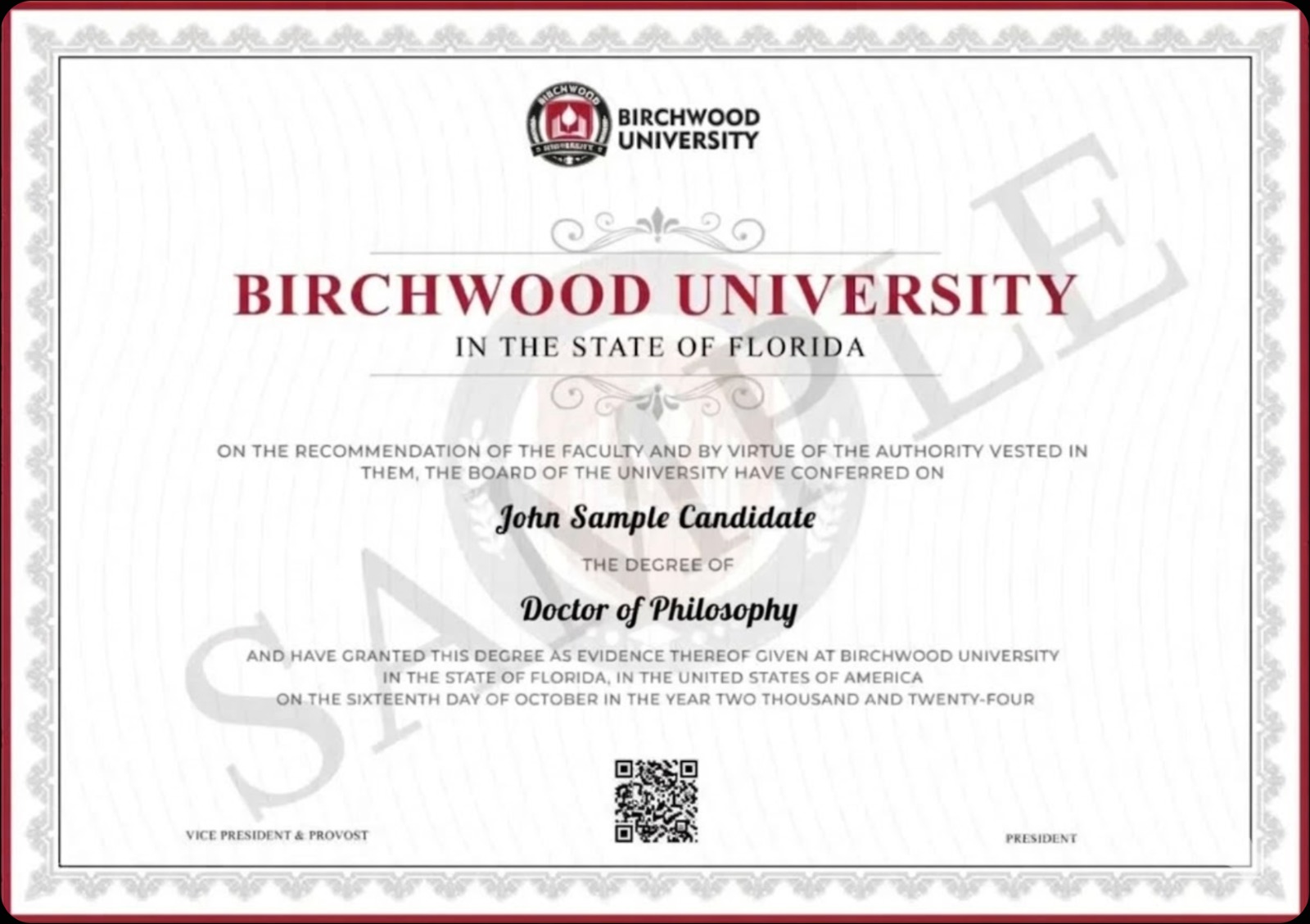
Certificate

Programme Fee

Total Programme Fee USD 9500

Call +91-8130038548 to know more about attractive financing options, as well as INTRODUCTORY limited-time upfront payment discounts up to 45% on the Programme Fee that you may be eligible for!

Payment Option 1

Make a down payment of USD 300 and, with an upfront payment of the full Programme Fee, avail a discount of up to 45% on the total fee.

Payment Option 2

Pay 50% of the Programme Fee at the time of Registration, and the remaining 50% within 6 months of Registration or before commencement of Semester 3.

Career Path

Graduates of the Ph.D. programme from Birchwood University are prepared for advanced roles across academia, industry, and research.

Academic & Research Leadership

University faculty roles, senior researchers, and scholarly contributors shaping academic excellence.

Executive & Strategic Leadership

Senior management positions, strategy heads, and policy advisors driving organisational growth.

Industry & Professional Consulting

Management consultants, research specialists, and transformation leaders across sectors.

Applied Research & Policy Development

Roles within think tanks, research institutions, and corporate research divisions influencing decision-making.

Entrepreneurship & Thought Leadership

Founders of knowledge-driven ventures, authors, speakers, and recognised industry authorities.

Why Choose a Ph.D. from Birchwood University?

Purposefully designed for accomplished professionals seeking advanced scholarly and industry impact.


  • Seamlessly integrates advanced theory with applied research across business, marketing, finance, economics, and strategic management.
  • Delivered by distinguished, industry-expert faculty with strong academic and professional credentials.
  • Structured, outcome-driven curriculum with early and continuous focus on dissertation development.
  • Flexible and blended learning format enabling balance between professional commitments and doctoral studies.
  • Strong emphasis on applied, practice-oriented research addressing real organisational and global challenges.
  • Cultivates leadership excellence, ethical scholarship, and advanced analytical capabilities for senior roles.
PhD Research

Research & Publications – BU Doctoral Programs

Researcher Profile

Marina Marjanović

Singidunum University

View Published Papers
Researcher Profile

Aida Mehrad

Associate Professor / Researcher / Associate Editor / Educational Supervisor

View Published Papers

Researcher Profile

Dr. Felixberto Cezar Condeza

Refereed Academic Conferences / Journals / Proceedings

View Published Papers

About Birchwood University

Birchwood University takes pride in its focused approach to education, concentrating on key domains that drive the future. The university aligns its programmes with the evolving needs of the professional landscape. It caters to a diverse range of academic pursuits, offering programmes from Bachelor's to Doctoral levels. This comprehensive spectrum allows students to embark on their educational journey with the university and progress seamlessly through various stages of academic advancement.

The university engages students in research activities, encouraging them to explore, innovate, and contribute to the body of knowledge in their respective fields. The University stands at the forefront of futuristic education, specialising in Data Science, Cyber Security, Software Development, and Management courses. Birchwood University, authorised by the Commission of Independent Education (CIE) in Florida, USA, holds a prestigious position in the global education landscape.

Frequently Asked Questions

For quick answers, browse our Frequently Asked Questions below.

This program is designed for experienced professionals and blends advanced theory with real-world application. It emphasizes industry-relevant research, flexible learning options, and early dissertation development guided by expert faculty who bring both academic and practical insights.

The program is ideal for mid- to senior-level professionals who want to deepen their expertise, conduct meaningful research, and advance into leadership, academic, consulting, or high-level industry roles.

Yes. Applicants must have a master’s degree in business, management, organizational studies, or a closely related field from a regionally accredited institution, with a minimum GPA of 3.0.

Yes. Applicants must have relevant work experience in for-profit organizations, non-profits, government agencies, or NGOs. This ensures that students can directly apply their learning and research to real-world challenges.

No. GMAT/GRE scores are not required for admission. However, you may submit them to be considered for scholarships.

The curriculum includes progressive learning of advanced theories, theme-based semesters, early dissertation planning, and a strong focus on practical research application. The program blends interactive in-person sessions with comprehensive virtual support.

Students are required to conduct original research that addresses practical challenges in industry or organizations. The dissertation must demonstrate deep subject-matter expertise and contribute meaningful insights to the field.

Yes. The program is designed for professionals managing full-time careers. It offers flexible scheduling, virtual support, and a structured progression that allows students to balance work and doctoral studies effectively.

Applicants must submit an essay explaining how earning a Ph.D. will enhance their knowledge and contribute to their career goals. They must also provide official transcripts, a government-issued ID, a resume, and may be asked to participate in an interview. All non-English documents must include certified translations

To graduate, students must complete original dissertation research and successfully defend their dissertation before an academic committee, demonstrating academic rigor, original thought, and scholarly contribution.

You may choose to opt out of this programme and request for a refund any time before commencement vide an email. Your refund will be processed after deduction of processing charges of USD 150. No refund request will be considered or processed, once the cohort commences and any amount paid will be forfeited.

Apply Now

Get Free Admission Counselling.